

September 2023 - Smart Solar Nepal

RENEWABLE ENERGY

Renewable energy, also called alternative energy, usable from replenishable sources such as the sun (solar energy), wind(wind energy)river(hydroelectric energy), hot springs (geothermal energy), tides (tidal energy), and biomass (biofuels).

Historical Overview

1954 – Daryl Chapin, Calvin Fuller and Gerald Pearson invented a silicon PV cell in Bell’s lab which had 4% efficiency.

1918 – Jan Czochralski discovered a method for production of monocrystalline silicon cell which was constructed in 1941 for the first time.​

1883​ – Charles Fritts invented first selenium solar cell​.

1839​ – Edmond Becquerel

Solar Energy

  • Solar energy is the energy which is harnessed from the sun energy, causing chemical reaction and generating electricity.
  • Solar radiation may be converted directly into electricity by solar cells (photovoltaic cells).
  • The single cell generally does produce 2W, while connecting large number of individual cells as in solar panel arrays hundreds and thousands of KW electric energy can be generated.

Solar Panel

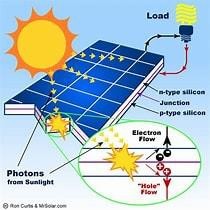
  • Solar panel works by allowing the photons , or particles of light, to knock electrons free from atoms, generating a flow of electricity.​
  • Solar panels basically consists many smaller units called photovoltaic cells — this means they convert sunlight into electricity.​​


Types of solar panel 

    • Monocrystalline: Higher performance and efficiency, Higher cost.​ ​
    • Polycrystalline: Lower performance, Lower efficiency and lower performance.

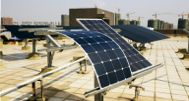
    • Thin-film: Portable and flexible,  Lower performance and lower efficiency. 
Charge controller

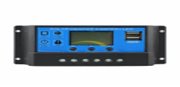
  • Charge controller manages the battery charging process.
  • Prevents from overcharging and discharging.
  • Charge the battery on the constant basis during over voltage and under voltage situation.
  • Helps monitoring the solar panel system.
PWM controller​
PWM controller​
MPPT controller​​
MPPT controller​

Battery

​Lithium– ion Battery

Pros: 

  • Stores much higher energy in the less space and discharges all the energy.
  • High efficiency.
  • Larger lifespan at least of 10 years warranty period.
  • Can be installed by any company accurately and safely.
  • Mostly used in residential area as, it can hold more energy in smaller space.
  • Might easily catch fire but a good installation process can cope this problem easily.
  • Expensive.

Lead– acid Battery

Pros:

  • Stores the energy for much longer time.
  • Highly reliable.
  • Cheaper.

Cons: 

  • Requires  ventilation and regular maintenance.
  • Low DOD(depth of discharge) that means shorter lifespan around 5-10 years.

Nickel Cadmium battery

Pros:

  • Highly durable.​​
  • Doesn’t require complex battery management and are maintenance free.​​
  • Ability to operate at extreme temperature.​​

Cons: 

  • Cadmium is highly toxic so couldn’t rule the market.​​
  • Difficult to dispose and recycle.
  • Due to memory effect couldn’t hold the charge.

Flow battery

Contains water- based electrolyte that flows between two chambers within the battery and when charged, chemical reaction occurs and that let the energy to be stored  and discharged subsequently.

Pros:

  • Liquid used is fire retardant so no risk of thermal runway.​​​
  • 100% DOD that let us to use all the energy stored in the battery without damaging the battery’s life.​​​
  • Longest lifespan of around 30 years.​​​

Cons: 

  • Highly expensive.​​​
  • Larger size.​​
  • Relatively low storage capacity so for higher storage of energy they need to be in bigger size.

Solar Inverter

  • Inverter simply convert or invert the direct current produced by panel into alternating current.​
  • String or central string inverter​
  • Smaller solar arrays may use this type of inverter.
  • DC current produced by the panel and through the circuit harness and finally to the single string inverter .

Pros:

  • Easier installation due to fewer parts.​​​
  • Least expensive.​​​
  • Easier maintenance due to installed in roof as have easier access.​​​

Cons: 

  • Can limit the power production if complexity in roof design and system.​​​
  • Drop in production of single solar panel due to shading can hamper the production of whole string.

Optimized String Inverter

Optimized string inverter has the one power optimizer that let the energy to be  optimized to certain threshold and send it to the inverter, which converts the dc power to the ac power.​​

Pros:

  • Consistent power flow to the converter .​​​​
  • Warranty extended to 25 years.​​​​
  • Optimize the power production even in the complex roof and system design.
  • Enable the power production data and monitoring at individual panel level.

Cons: 

  • Expensive.​​​​
  • Some optimized string installed in factory may not be repairable at that time panel needs to be replaced.

Micro Inverter

Micro inverter convert the dc into ac at panel level that is micro inverter is installed at every panel.​​​

Pros:

  • Optimization of energy conversion at panel.​​​​​
  • Suitable for complex roof and system design.​​​​​
  • The poor performance of one panel doesn’t hamper the production of entire energy.
  • Help to enable the power performance data and monitoring of individual panel.
  • Maximum power production even in the shading.

Cons: 

  • Highly expensive.​​​​​
  • Difficult to repair as they are installed in the roof under the panel.

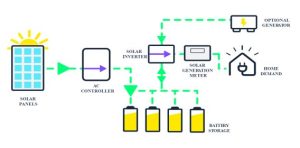
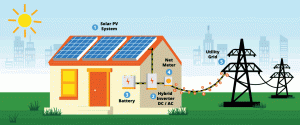
Hybrid Inverter System

  • ​​​Multi-mode inverter with a battery backup system.​​
  • Convert the energy from the solar array and battery and the grid before available.

Pros:

  • Intelligent and programmable device.​​​
  • Can utilize with or without battery backup.​​​​
  • Time tested in off- grid system.
  • All in one system.

Cons: 

  • Can reduce the energy efficiency. 
  • ​​​Limitation in system design.

Types of Solar Power System
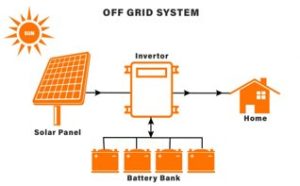
Off- grid solar power system​​

  • Suitable for the remote areas where there is no access of electricity and where they have  to fully depend upon their own.
  • Generator backup for supplement production during bad weather condition for long time.
  • Battery backup system makes it more expensive.
  • Energy consumption can be limited.
Off grid pv system
Off grid pv system

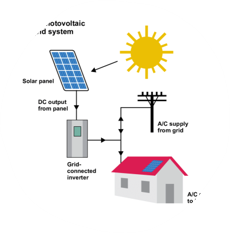
On- grid solar power system​​

  • Suitable for the remote areas where there is no access of electricity and where they have  to fully depend upon their own.
  • Generator backup for supplement production during bad weather condition for long time.
  • Battery backup system makes it more expensive.
  • Energy consumption can be limited.

On Grid PV System​
On Grid PV System​

Hybrid Solar Power System

  • ​Have both feature of on-grid and off-grid solar power system.​
  • Battery backup is there so in case any interruption in the power supply during the bad long stretches in weather condition or at night or any and from the grid, consumer doesn’t need to suffer.​
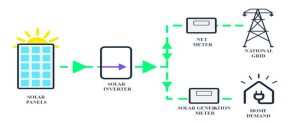
  • Net metering is there for the energy calculation for incoming and outgoing energy.
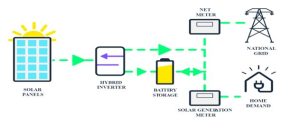
Hybrid pv system​
Hybrid pv system​

PROMOTING DIVERSITY AND INCLUSION IN THE ENERGY SECTOR OF NEPAL

Significant energy disparities exist in the world, both between and within individual states as well as between affluent and poor countries. These disparities exist both in urban and rural areas, as well as within individual households. The Sustainable Development Goal-7 of the UN emphasizes the need for universal access to affordable, dependable, sustainable, and modern energy  while  also  recognizing  its  key role in overall development. Deeply rooted structural variables including gender, caste, ethnicity, religion, language, and location, as in the case of Nepal as in many South Asian nations, contribute to unequal access to and benefits from energy resources. Energy poverty affects women, the poor, and marginalized groups more severely than it does relatively advantaged groups. 

Nepal’s energy sector is at a pivotal juncture, with rapid growth and development taking place. As the country endeavors to meet its increasing energy demands and achieve sustainability goals, it’s crucial to address issues of diversity and inclusion within this dynamic industry. This blog explores the importance of promoting diversity and inclusion in the energy sector of Nepal, backed by accurate data and insights. 

Nepal’s government, development organizations, and civil society have all implemented different policies and programs to alleviate these discrepancies. The degree to which these actions have actually improved the lives of the local community, particularly the women, the poor, and those who are marginalized, is still unknown. In addition, Nepal must simultaneously provide fair energy access and address the distributive effects of the development of the energy sector while increasing its energy resources to achieve its ambitious economic plan. The purpose of this study is to offer a thorough examination of GESI (gender equality and social inclusion) problems in Nepal’s energy sector. It looks at the prospects and challenges of closing the energy gap and ensuring fair access to and benefits from energy for all societal groups. 

The Current Landscape: 

Nepal’s energy sector primarily consists of hydroelectric power, followed by solar and wind energy. Despite its significant contribution to the nation’s economy, the sector has traditionally faced challenges in promoting diversity and inclusion. 

Gender Disparity: 

In the energy sector, there has been a noticeable gender gap. According to the World Bank, as of 

2021, women constituted only about 21% of the workforce in Nepal’s electricity sector. This underrepresentation of women in energy roles underscores the need for gender diversity. 

Rural-Urban Disparity: 

Another aspect of diversity relates to geographic inclusion. Nepal’s energy infrastructure development has predominantly favored urban areas, leaving rural regions with limited access to reliable electricity. Bridging this gap is essential for overall inclusive growth. 

Promoting Diversity and Inclusion 

Gender Inclusion: 

Initiatives  aimed  at  increasing  the  participation  of  women  in  the  energy  sector are crucial. Encouraging more women to pursue careers in engineering, renewable energy, and management roles can diversify the workforce.Encourage and prepare young women in Nepal to pursue a career and take on leadership roles in the energy sector by increasing their access to information and  opportunities.Providing  mentorship,  scholarships,  and  support  for  women  in  STEM education is a vital step. 

Geographic Inclusion: 

Expanding  energy  access  to  rural  and  remote  areas  is not only an inclusive move but also contributes to poverty reduction. Off-grid renewable energy projects, like solar mini-grids and micro-hydro schemes, can play a significant role in this context. 


Inclusive Policies: 

The  government  of  Nepal  has  a  pivotal  role in shaping policies that promote diversity and inclusion in the energy sector. This includes creating an enabling environment for women and marginalized communities to participate in decision-making processes and access funding opportunities. 

Benefits of Diversity and Inclusion 

Innovation: Diverse teams bring a range of perspectives, fostering innovation and creative problem-solving. In the energy sector, this can lead to the development of more efficient and sustainable technologies. 

Economic  Growth:  Expanding energy access to underserved regions can stimulate economic growth. As rural communities gain access to electricity, opportunities for entrepreneurship and employment increase, contributing to poverty reduction. 


Social Equity: Promoting diversity and inclusion in the energy sector aligns with the principles of social equity. It ensures that benefits and opportunities are distributed more equitably among different segments of society. 

Conclusion 

Promoting diversity and inclusion in Nepal’s energy sector is not just a matter of social justice; it’s also a strategic imperative for the nation’s sustainable development. By addressing gender disparities, bridging geographic gaps, and implementing inclusive policies, Nepal can harness the full  potential  of  its  energy  sector  while  leaving  no  one  behind.  It’s a journey that requires collaboration among government, private sector, and civil society, and it’s a journey worth taking for a brighter and more equitable energy future. 

Solar PV in Nepal: A Bright Future For Clean Energy 

Around 20% of Nepal’s total energy consumption is made up of modern energy sources including electricity, petroleum, and renewables, and this percentage is steadily rising and can be attributed to Nepal’s brisk urbanization. Petrol use leads all sources of contemporary energy with a share of roughly 65% of overall consumption; electricity has a share of about 15%; and the remaining 20% is made up of other contemporary energy sources like coal and others[1]. The Government of Nepal (GoN) pledged at COP26 to attain net- zero emissions by 2045, but the goal now appears much more ambitious given the recent increase in the share of renewable energy sources. Hydropower is used to generate the majority of the nation’s electricity, and the majority of these sources are Run of River (RoR) types. The RoR type hydropower’s production highly depends upon the amount of rainfall in the country and has high seasonal fluctuation. Hence depending nation’s majority of electrical sources on a single source is dangerous and can cause catastrophic energy blackout. Solar PV a globally recognized and in trend in later decades is a promising technology which could secure the energy insecurity of Nepal. Solar PV comes into account in two major ways one, as cheap, green, and sustainable energy technology and another as diversifying the energy production in the country.


Energy security and independence 

The first and most reasonable approach for promoting solar in Nepal is to increase the domestic energy generation. In Nepal, we do not have significant sources of petroleum which is dominating the proportion of modern energy usage in the country. The domestic consumption of electricity increases from 7,275 GWh in FY2020/21 to 8,823 in 2021/22 and at present total installed power plant capacity is 2265 MW, out of which, 74 MW from off-grid, and 2191 MW connected to grid. Among the grid connected generation facilities, 49.76 MW from solar, 53.4 MW from thermal, 6 MW is biomass, and the rest 2082 MW from hydro[2]. Off-grid isolated generation capacity of 74 MW developed through different sources by Alternative Energy Promotion Centre (AEPC) is also included in the installed capacity. The figure of total grid connected solar power generation add up to 87MW at the end of third quarter of 2023 among which

61MW is from IPPs and rest 26MW is from NEA. This makes solar PV the third largest source of electricity contributing nearly about 3% of the total grid connected electricity in Nepal and all the pipeline solar PV projects when completed contributes 5.03%, considering current generation from all other sources. Recently

40 solar plants got the license for surveying which could add 708 MW of grid connected generation facility in Nepal. This marks the acceleration of the development of solar power plants to meet the target to generate

1500-2250 MW of electricity of solar PV in 10 years.

According to Nepal Energy Outlook 2022, the country’s energy security is threatened by the trend of changing energy use for three reasons. First, even with the current level of import of modern fuels, cash outflow has exceeded the net income from all exports by the nation, which is alarming. Second, due to limited foreign currency reserves, Nepal may not be able to afford to buy and import the necessary quantity of modern fuels in the near future. Third, due to the depletion of natural reserves of modern fuels, especially the fossil fuels, prices of such fuels are skyrocketing in the international market and may be unaffordable soon. All of these call for increasing domestic energy output, making solar photovoltaic technology an excellent option to take into account. In recent years Nepal has become net importer to net exporter and along with that, NEA was able to increase the revenue and hence improve the financials of the organizations and the major credit goes to the recently commissioned projects including hydropower, solar power plants with transmission lines and other facilities. Witnessing the rapid development of electric generation in the country might seems well enough to satisfied but there might be some risk depending heavily on single source, as we have witnessed the rise, and fall of other technologies like the nuclear power in the 20’th century.


Solar PV as a viable solution

Solar power system is an energy generation system in which the energy of sun (the radiance energy) is converted to electrical energy which is done by solar module. A solar module is a modular device that consist of array of solar cells which are connected in combination of series and parallel connections. The power rating of a solar module varies but modules of 250wp to 450wp are widely used for residential, institutional as well as commercial solar PV system. Numbers of modules are connected together to form solar array which multiplies the current and voltage of a single solar module to generate adequate power to be supplied to the load directly or after converting to AC power. Generally, the DC power available is then converted to AC power and then supplied to the load however is small systems individual inverting units called microinverters are used. Since solar radiance is only available for certain hours a day, energy backup system is required to redeem the load requirement, in some cases energy is taken from the grid at the time of non-sun hours, in other cases battery or other storage systems are used which is generally called off-grid solar power plants.

The solar potential in Nepal is 50,000 terawatt-hours per year, which is 100 times larger than Nepal’s hydro resource and 7,000 times larger than Nepal’s current electricity consumption. According to a report by The Himalayan Times, the solar resource in Nepal is good enough for the production of electricity at a cost of NRs 4,800 (US$40) per MWh once the solar industry becomes mature in Nepal, falling to below NRs 3,600 (US$30)/MWh in 2030. In average the global solar radiation varies from 3.6-6.2 kWh/m2 day in Nepal. In a year, for about 300 days, sun shines. The number of sunshine hours amounts almost 2100 hours per year and average insolation intensity about 4.7 kWhm-2 day-1 (=16.92 MJ/m2 day) which makes Nepal’s geographical location a favorable insolation zone for harnessing solar energy[3].


Benefits

The major drawbacks of petroleum are the emission of greenhouse and other harmful gases which negatively affect the environment. As a renewable source of power, solar energy has an important role in reducing greenhouse gas emissions and mitigating climate change, which is critical to protecting humans, wildlife, and ecosystems. Solar energy can also improve air quality and reduce water use from energy production. Beside environmental benefits there are several economic benefits of solar power including quick return of investment (ROI), very low operating cost, low maintenance cost as there is no moving parts etc. Also, off grid solar system can electrify the rural parts where there is no access to grid electricity. 


Government policies and initiatives 

The government has been overseeing and supporting renewable energy projects through the Alternative Energy Promotion Centre (AEPC). AEPC provides information and awareness about alternative resources, provides financial assistance to promote renewable technologies, and advocates the use of alternative energies. Categories of solar PV systems are domestic (rooftop) PV for 500W to 10KW, 

Institutional PV for 10KW to 500KW plants and commercial PV for more than 500KW capacity plants as mentioned on Grid Connected Alternative Energy Working Procedure 2074. Also assures the provision 

for connection to national grid for all three categories of solar PV under capacity of 1MW systems after applying to NEA but prosumers do not need to apply in case of net metering. Any discounts and  privileges are to be claimed through Alternative Energy Promotion Center (AEPC). For plants bigger than  1MW one year is given for the survey and must be completed and commissioned within two years and has the contract period of 25 years[4]. The supply of energy from any types of renewable energy is based on the concept of take or pay and has set the purchase rate of NPR 7.30 per unit[5], however Nepal Electricity Authority’s board meeting decided to conduct solar PPA through a competitive bidding process to make solar energy more accessible and competitive, following international trends which sets the purchase rate of NPR 5.94 per unit. The Renewable energy subsidy policy categorized into three regions, category A, category B and category C regions which gets the subsidies differently. 

The Nepal Electricity Authority had previously entered into PPAs for 110.36 MW with 17 solar projects, out of which 85.26 megawatts are from the private sector, and 26 megawatts are from the authority, all connected to the national transmission line for solar energy. Recently 40 power plants ranging from 1MW to 250 MW in capacity got license for surveying which could add up to 708 MW. This approach seems to indicate the NEA and other Independent Power Producers (IPP)’s attraction towards solar energy as a viable alternative and a good investment. 


Challenges and Solutions 

Solar can play a significant role in balancing seasonal fluctuations in load demand in the country, however balancing the daily fluctuation can still be challenge since the technology have to heavily depend upon backup energy or storage system during non-sun hours. And the major challenge is lag in the technological development of storage systems specially battery technology to catch up with the accelerative development of solar panels. However, Nepal can benefit from its geography by constructing integrated solar and hydropower plants also known as Pumped Hydro Energy Storage System (PHES) are also constructed in several countries in the world China being at the top. In this system hydropower acts as storage unit for solar PV plant and the hydro machine (either RPT or PAT) can work as a pump or as a turbine working between upper and a lower reservoir. According to the Global Pumped Hydro Atlas, Nepal has 2,800 good storage sites, which is 50 times more than needed even after Nepal catches up with the developed countries.