
ssnc, Author at Smart Solar Nepal - Page 2 of 2

Grid Modernization: Beyond Smart Grid

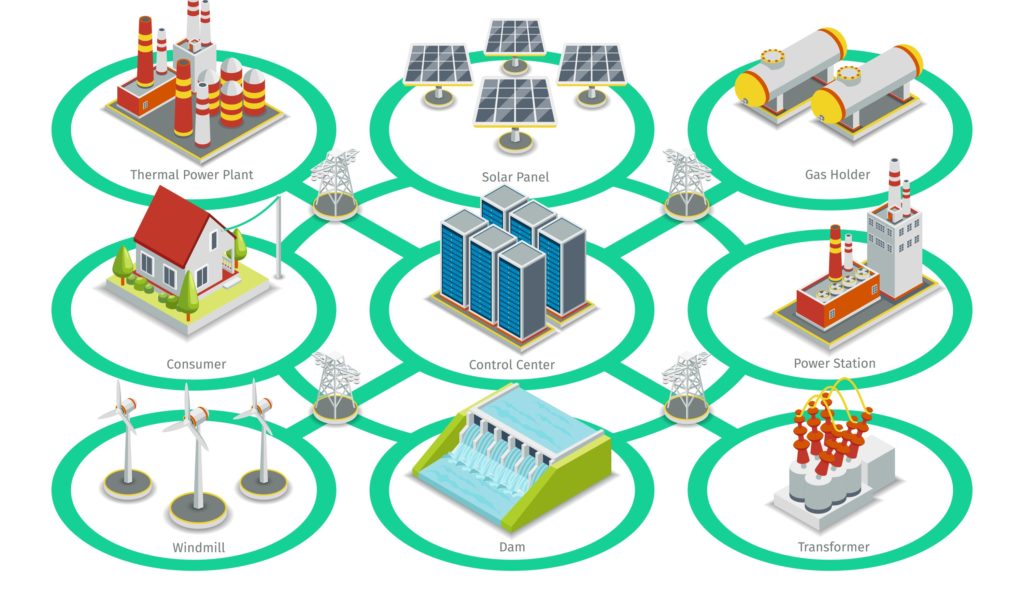
The world is modernizing at such a rapid rate, everything has been upgraded from manual control to semi (nowadays mostly) automated systems. Such that electrical generation, distribution, and consumption is not far from this modernization. Hence, the Smart Grid concept has been introduced. Smart Grid (SG) does not have a unique definition to precisely describe the phenomena. However, the smart grid can be simply defined as an intelligent network that is automated and able to store, communicate, and make decisions. Different countries have different policies and concepts regarding smart grids but the integration of large-scale renewable energy, improvements in the reliability of services, and the achievement of higher levels of energy efficiency, etc. are common interests. The main need for the development of grid modernization is that the grids of today will not support the energy goals of the future. A few years back the challenge was producing sufficient energy supplies but now it is important to produce sufficient with minimal impact on the environment. ”The greener the better”, this concept has been prioritized.

Smart Grid Technologies

Numerous technologies can be implemented to achieve successful control and automation in smart grids. Such technologies are imperative to facilitate the transition toward a well-functioned

infrastructure from the perspective of grid designers and consumers. These technologies may include Automatic Voltage Regulation (AVR), Energy Management System (EMS), Automatic Generation Control (AGC), Advanced Metering Infrastructure (AMI), Meter Data Management (MDM), Distribution Management System (DMS), Geographical Information System (GIS), Outage Management System (OMS), Wide Area Management System (WAMS), and Demand Side Management (DSM).

Demand Side Management/Demand Response (DSM/DS)

Demand response has a vital role in shaping the future power grid in addition to the storage technologies, distributed generation, and communication infrastructure. Demand response can be classified into Price-based programs and Incentive-based programs. Attractive schemes can be launched hence, the changes in electric usage by consumers from their normal consumption behavior in response to new pricing schemes, elevated sense of responsibility, and incentive pricings that are mainly designed to induce lower electricity consumption during high price periods or when system reliability is jeopardized can be achieved.

Advanced DSM applications

  • Maintenance and outage planning
  • Retail power marketing
  • Distribution Simulation
  • Distribution power flow
  • Short circuit analysis
  • Optimal capacitor placement
  • Feeder relay protection coordination
  • Real-time DMS

Data Management

One of the main characteristics of Smart Grid is the Data Management system. It consists of various approaches for the management of data collected. Data collection can be done remotely or through real-time tracking. Different AI has been developed for real-time data tracking of Generation, Distribution, and Consumption.  It consists of various steps such as:

  • Data Collection
  • Data integration
  • Data Storage
  • Data Analysis
  • Data Visualization
  • Decision Making

Morden-day AI-based data management system allows online/on-time decision making. Several data loggers can transmit data in smart grids such as sensors data, power metrics data, mobile terminals, control devices, historical data, and reliability data. It saves a lot of time allowing the system to work a little faster and in a reliable manner.

Use of Smart Meter

The smart meters allow two-way communication between the end-users and the service provider. This enables consumers to control their energy usage and ensures more accurate billing. In addition, smart meters can provide power outage notifications and power quality monitoring. For a demand to be controllable, smart meters are often used since they possess a two-way communication that allows system operators or aggregators to effectively control loads. For instance, the ability of smart meters to control domestic demands for frequency regulation purposes. Hence, Smart Meter is a game changing device developed  ensuring the future Grid modernization beyond Smart Grid.

Advantages

  • Time-saving.
  • Improve the reliability and quality of the infinite grid.
  •  Optimize the smooth operation of the existing setup reducing the future expansion of backup plants.
  •  Increases the overall system efficiency.
  •  Improves cooperation of Distributed Resources.
  •  Enable automatic maintenance
  •  Lower greenhouse gaseous emissions.
  •  Improvement of the system to ensure and enhance system security

Challenges and Drawbacks

Every system or its development has its drawbacks and challenges. Battery backup systems and cybersecurity can be the major threats to the grid modernization system. Energy Storage Systems are fundamental parts when it comes to renewable energy resources integrated into smart grids. The application of energy storage is not new, yet the technologies require further developments. Their operation and size need to be carefully optimized.

The advanced automation and communication capabilities in smart grids expose the entire system to cyber threats. The consumer’s data are in constant threat and can be achieved by any person at any time. Therefore, the data need to be encrypted to avoid future threats.

Conclusion

According to various research articles, the paper published, and attended webinars, the future of modernization in the smart grid is the developed AI that facilitates two-way communication at every point of the system if possible.

Some of the important findings are listed below:

  • Development of optimized battery size and service.
  • Achievement of improved Cyber Security System.
  • Need of integrated energy system with renewables like solar, wind, etc. for the reliable power source
  • Smart generation, smart distribution, and smart consumption should be achieved.
  • Need for development of more advanced AI.
  • Automation and Visualization.
  • Test, Test, and Test as there would be more time-consuming changing the system.
  • Two-way communication from every point is necessary.
    • Communication between Generation and Consumption
    • Communication between Generation and Distribution
    • Communication between Distribution and Consumption

Hence, if there is proper communication between the different systems then reliability in the power supply can be achieved. Problems that arose can be solved in less time and there won’t much hamper to the whole system and consumers.
Environmental Impacts of Solar Photovoltaic System

The annual increases in global energy consumption, along with its environmental issues and concerns, are playing significant roles in the massive sustainable and renewable global transmission of energy. Solar energy systems have been grabbing most attention among all the other renewable energy systems throughout the last decade.

Since PV technology generates electricity directly from solar energy, it is free from fossil fuel consumption and greenhouse gases (GHG) emission during its operations. Thus, it seems to be completely clean and have no environmental impacts. However, during its life cycle, it actually consumes some energy and emits GHG during some stages such as solar cells manufacturing processes, PV module assembly, Balance of System (BOS) production, material transportation, PV system installation and retrofitting, and system disposal or recycling. These are the stages where solar actually has an environmental impact.

Life cycle assessment (LCA) is usually conducted to accurately investigate the environmental performance of PV systems. LCA is a methodology for assessing environmental impacts associated with all the stages of the life-cycle of a commercial product, process, or service. The following table shows the breakdown of lifecycle greenhouse gas emissions for PV in total percentages.

Table 1: Breakdown of lifecycle GHG emissions for solar PV and wind energy (% of total)

Energy  SourceFabricationConstructionOperationDecommissioning
Solar PV71.3%19%13%-3.3%
Wind71.5%24%23.9%-19.4%

It is evident from the table that fabrication is responsible for the largest share of emissions, followed by construction and operation.

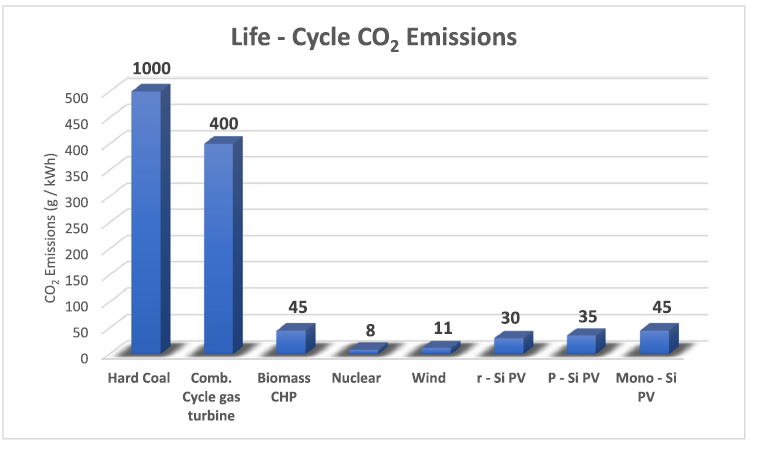
The following figure shows the life cycle CO2 emissions of conventional energy supplying technologies and some renewable energy sources and compares them to the Mono-Si, P\\Si, and r-Si PV technologies.

Life Cycle CO2 emissions comparison between PV technologies and other energy supplying technologies
(Alsema and deWild, 2005).

EPBT (Energy Payback Time) is regarded as a perfect evaluation indicator for sustainability through which we can clearly determine whether the specific PV system can bring a net gain of energy for the user during its lifetime and if so to what extent. The EPBT indicator is defined as the years required for a PV system to generate a certain amount of energy (converted into equivalent primary energy) for compensation of the energy consumption over its life cycle, including energy requirements in PV modules’ manufacturing, assembly, transportation, system installation, operation and maintenance, and system decommissioning or recycling.

In 1970, the average energy payback time for solar panels was 40 years. By 2010, that number had dropped to just six months. With technological advancements, solar panels are being more efficient which means that solar’s EPBT will continue to decrease.

Impacts to air

The impact of PV energy on air quality and climate change is significantly lower than any other traditional power generation system. Hence, it can assist in eliminating numerous environmental issues that resulted from utilizing fossil fuels. PV systems have zero emissions of carbon dioxide (CO2), methane(CH4), sulfur oxides(SOX), and nitrogen oxides(NOX) during operation with negligible effects on air pollution and global warming.

It is also estimated that the use of PV systems can lead, by the year 2030, to a reduction of CO2, SO2 and NOX emissions by around 69–100 million tons, 126,000–184,000 tons and 68,000–99,000 tons, respectively. These reductions in emissions are projected to lead to a significant drop in several dangerous diseases such as heart attacks and asthma that are expected to decrease by 490–720 and 320–470 annually, respectively.

Land use

Typically, the land requirements for solar projects are larger than conventional fossil fuels’ projects. Utility-scale solar power plant requires large areas for energy production. Due to this, the facilities may interfere with existing land uses and can impact through material exploration, extraction, manufacturing and disposal. Several reports and studies show that solar power systems (PV and Concentrated solar power (CSP)) have the highest energy land use intensity compared to other energy technologies. Table 2: Land requirement for various sizes of solar and wind technologies.

Technology TypeSize (acres/MW)
PV <10 kW3.2
PV 10100 kW5.5
PV 1001,000 kW5.5
PV 110 MW6.1
Small PV (>1 MW, <20 MW)5.9
Fixed5.5
1-axis6.3
2-axis flat panel9.4
2-axis Concentrator photovoltaics (CPV)6.9
Large PV (> 20 MW)7.9
Fixed5.8
1-axis9.0
2-axis flat CPV6.1
Small and large PV installations2.2–12.2
Small and large CSP installations2.0–13.9
PV panels installed in parallel6.1
PV parks8.1
Wind <10 kW30
Wind 10 100 kW30
Wind 100- 1000 kW30
Wind 1 10 MW44.7

However, certain technologies have been developed to reduce land use without compromising the efficiency of solar system such as a dual-angle solar harvest system a two tilt angle solar array. To avoid the conflict with agricultural land, PV systems can be installed in degraded areas, deserts and no cropping land. Land use can be also reduced by employing floating PV (FPV) systems. In FPV systems, the PV panels are laid on top of a structure that floats in a water body. FPV systems are found to be more efficient than inland PV systems because of the continuous cooling caused by water evaporation at the back of FPV panels. Another advantage of using FPV is decreasing the water losses from freshwater bodies.

Water usage

The water consumption in PV systems during operation is insignificant. During operation, water is used mainly for panels cooling and cleaning. The water consumption during the manufacturing and recycling processes is considerably higher than the water consumption during operation.

Other technologies such as nuclear, natural gas, coal-fired facilities, all require massive amounts of water for cooling purposes. Solar energy imposes no risk to local water resources, nor their operation strains local supplies by competing with agriculture, drinking systems and other vital water needs.

The results showed that photovoltaics has the lowest footprint in water usage compared to other renewable technologies as depicted in Table 3.

Table 3: Median of water consumption in a full life cycle for different energy generation technologies.

Energy TechnologyMedian of Water Consumption
(L/MWh)
Biomass85,100
Hydropower85,100
Oil3,220
Nuclear2,290
Coal2,220
CSP1,250
Geothermal1,022
Natural Gas596
PV330
Wind43

Noise

PV modules do not contain moving or rotating parts, hence, there is no significant noise pollution produced during their operation. However, during the construction phase, many heavy machinery and vehicles operate on the site which causes noise pollution for residences, travelers, and wildlife.

PV systems not only impose zero noise pollution to the environment but also can be used as noise barriers (NB) which helps in mitigating noise. These are usually top-mounted near highways and provide the dual combination of combating noise while providing electricity. Configurations are shown in the figure below.

Different possible PVNB configurations

Hence we can conclude that the environmental impact of solar energy is net positive and have minimal impact compared to other energy generation technologies. PV in general emits no GHG during its operation. Electricity generation with solar energy instead of coal and other sources can significantly reduce greenhouse gas emissions resulting a better and cleaner environment. Although it emits some GHG during some stages of its life cycle, the total GHG emitted during its whole life cycle is the least compared to other sources of energy. Further, researchers are investigating many improvement approaches to lower the PV carbon footprint. This can be achieved by adopting best practices in design and deployment phases that lead to better performance and reduce the overall emissions. Some attributes such as: increase lifespan; increase system capacity; increase irradiance (desert); use of renewable energy mixes and thin-film (CdTe) or cadmium selenide (CdSe) quantum dot PVs, should be taken in consideration to reach the lowest gases emission levels.

References

M. Tawalbeh, A. Al-Othman, F. Kafiah, et al., Environmental
 impacts of solar photovoltaic systems: A critical review of recent progress and future
 outlook, Science of the Total Environment (2020)
 Malek Kamal Hussien Rabaia, et al., Environmental impacts of solar energy systems: A review, Science of the Total Environment (2021)
 https://news.energysage.com/what-is-the-environmental-impact-of-solar-energy/

Blockchain In Energy Trading

Blockchain is the digital ledger of transactions that is distributed across the entire network of computer system. It is decentralized data network system in which each node can transact with the all other available nodes in the decentralized ledger platform in which datas are continuously updated and secure through encryption. The P2P (peer-to-peer) trading system allows any unit of generated electricity to be recorded in a blockchain allowing the owner of this generated energy to sell it to others.

Each node of blockchain is a smart home consisting of Internet Of Things (IoT) devices, energy storage device, home miner and solar panel only for prosumers that produce renewable energy itself. IoT devices are connected via WiFi, so they exchange data with home miner by wireless communication. The data generated in the smart home is called transactions. The transactions are added to the block by adding parameter including ID of device, ID of home owner, transaction type by the home miner after being authorized.

Energy trading using blockchain technology includes the writing of smart contracts which are digital agreements without the intervention of the third party. The energy trading has to be autonomous in nature, transparent and reliable. This would allow prosumers to engage in trading electric energy in a decentralized manner. Once an agreement has been reached between prosumers and consumers, the agreed price will be locked on the consumer’s account. For example, if a seller announces the price per unit of energy is $0.3 and another seller announces it as $0.25. In this situation, the buyer has two different options that he can buy power from any one of them obviously from the second one due to a lesser price. Trading happens in this way automatically and autonomously due to the smart contracts. There are various trading models depending on the different blockchain algorithms.

Smart Contract

Smart contracts are written in digital form as the name suggests. A Smart Contract is a contract, suitably coded, which automatically verifies the certain pre-defined conditions and executes actions when the conditions between the parties are verified. Smart contracts represent the responsibilities and conditions of the participant for the execution of contract. Smart contracts are programs that are built on the blockchain ledger and execute independently after the validation of transactions.

The main advantage of adopting smart contracts is its secured nature. When a smart contract between two parties is finalized, this information must be added to the blockchain. Once the new block is added to blockchain, a copy of new block is shared with all the other nodes (peers) in the network. Remaining nodes validate the new block and it is added to their local copies of blockchain through consensus mechanism.

Consensus Model

It is a process that leads to an understanding between people in the peer-to-peer network. This understanding is required in Blockchain Technology to validate a block and if it can be added to the block of blocks, this being done by miners, being rewarded for adding a block in the chain.

Consensus prevents malicious actors from manipulating data. Different blockchain implementations follow different consensus algorithms like Proof of Work, Proof of Stake etc. A transaction in the P2P network can be performed by any node and broadcast into the network. The nodes which perform Proof Of Work (PoW) are called miners and the node which successfully completes Proof of Work first is authorized to add a new block of transactions to the blockchain. After the successful completion of POW, they are paid incentives. Miners invest more CPU computational power to solve the PoW. The new authenticated block created by the miner is broadcasted to other nodes in the network to get consensus of majority of nodes. Proof Of Stake (PoS) is another consensus model that eliminates the need of investing more computational power as in the case of PoW.

Advantages

As the prosumer receives payment in the trading, this will encourage the distributed renewable energy prosumers and increase the usage of distributed renewable energy based generations. It enhances the long term energy security. This will play a important role in reducing the losses in the network and improves the stability of the power system. As the power sources are dispersed, the possibility to supply of electricity will be more stable and transfer renewable energy more efficient. By stimulating local energy production and consumption, the transmission losses are reduced.

The time-stamped chain of blocks with combined cryptographic hashes provides an immutable record of all the transactions in the blockchain network. Each block is identified by a hash, and carries a list of transactions. Hence, a chain of blocks is formed, and tampering of the previous blocks from attackers can be prevented.  This immutability feature of blockchain is achieved through the use of cryptography and hashing which makes the distributed ledger permanent and unalterable.

Challenges

Blockchain technology is comparatively new and lacks standardization. Some features of Blockchain are contradictory to some of the existing regulations of ‘right to be forgotten’, for the privacy of the data. However, Blockchain’s immutability feature does not allow any data to be erased. Thus, regulations need to be modified to use the features of Blockchain.

Blockchain users do not have the privilege to stay completely anonymous. Moreover, due to the transparency nature of the blockchain systems, every transaction is available publicly.  Details like the sender, receiver, and transaction information can be seen by all the parties of the network.  This will lead to the problems on the privacy of the user.

Since, blockchain work on a P2P network, there are chances of it to be vulnerable to a variety of security threats that includes hacks and viruses. It also can face various security attacks like the eclipse attack, block discarding attack etc. The 51% attack is the major challenge that the blockchain network can face. In this attack, a combination of miners controls more than half of the mining hash rate of the network. This allows the attackers to stop payments among a few or all of the users and also reverse the transactions.

The existing techniques used for consensus such as Proof of Work (PoW) are computationally expensive and consume considerable electrical energy. Along with these challenges, the opposition of the distribution utilities in the implementation of the blockchain in energy sector is also a recent challenge to overcome.

Conclusion

Blockchain technology is receiving the attention of power system utilities due to its flexibility in distributed control and more robust structure against attacks and data tampering. In parallel, cybersecurity concerns are increasing and researchers are exploring different cryptographic techniques to provide security and trust in the power utilities communication.

Blockchain is considered as the most disruptive technology ever born. It has the potential to eliminate the role of middle-man service in the supply chain. This will reduce the operational cost of the smart grid making electricity cheaper. Blockchain reduces cost associated with labor, data management, data visibility and inter system communication. Thus, the system is much inevitable for the grid management.

References

 [1] R.K. Kodali, S. Yerroju, B.Y. Krishna Yogi, “Blockchain Based Energy Trading” TENCON 2018 - 2018 IEEE Region 10 Conference (Jeju, Korea, 28-31 October 2018).
 [2] A. Salian, S. Shah, J. Shah, K Samdani, “Review of Blockchain Enabled Decentralized Energy Trading Mechanisms”, International Conference on system computation, Automation and Networking 2019.
 [3] E. Shaikh, N. Mohammad, “Applications of Blockchain Technology for Smart Cities”, Fourth International Conference on Inventive Systems and Control (ICISC 2020) IEEE Xplore.
 [4] S. Jae Pee, J. G. Song, E. S. Kang, J. W. Jang, “Blockchain based smart energy trading platform using smart contract”, ICAIIC 2019.
 [5] S.M. Suhail Hussain, S. M. Farooq, T. S. Ustun, “Implementation of Blockchain technology for Energy Trading with Smart Meters”, 2019 Innovations in Power and Advanced Computing Technologies (i-PACT).
 [6] ‘TransActive Grid, LO3 energy and consenSys’,https://lo3energy.com/, accessed on 24-02-2019.